

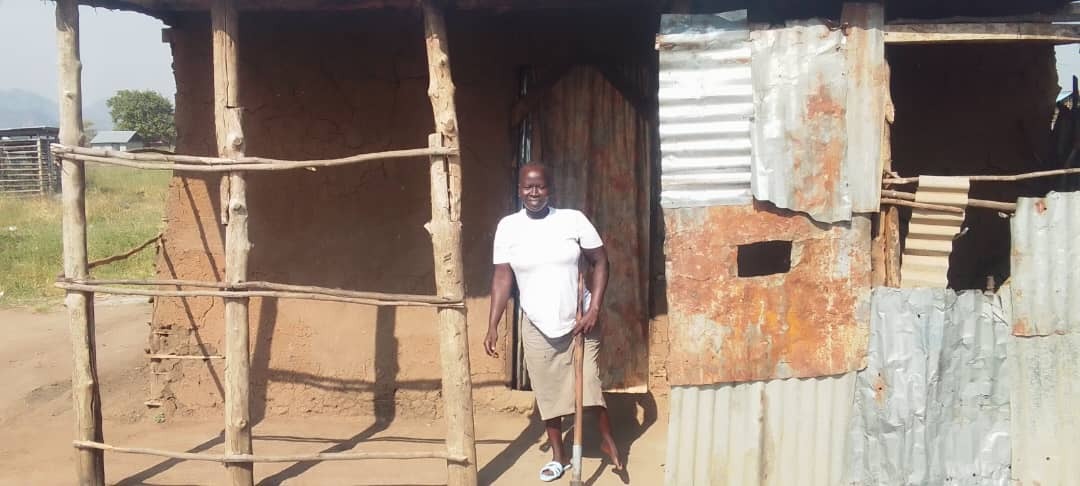
In a quiet corner of Juba’s Kapuri North area, Aida Beria, a 33-year-old physically disabled mother of five, is rewriting her story; one small sale at a time. Once struggling to meet her daily needs, she has now achieved what many only dream of; purchasing a piece of land through savings from her small-scale business.
“I started business by selling fruits. So, as the business grew, I moved to a bigger table. Through my business, I saved some money, and this is what I used for purchasing my land,” said Aida.
In a society where people with disabilities often lack opportunities, Beria’s determination allowed her to save enough from her small business to purchase land, an accomplishment many abled South Sudanese find difficult.
Beria attributes her transformation to an entrepreneurship training program she attended in 2019, organized by the Grassroots Women Network (GWN). Upon completion, each participant received 30,000 South Sudanese Pounds as start-up capital, which Aida promptly invested to begin her journey.
“They (GWN) trained us for five days and gave each one 30,000 SSP as start-up capital. We were instructed to start selling either groundnuts or liquid soap. While other women went for other businesses, for me I started fruits and liquid soap business. And that was where I generated a lot of money in Thongping neighborhood,” she stated.

Aida Beria standing next to her business in North Kapuri (photo -Dedi Esbon)
Beria’s story highlights the power of resilience and determination, demonstrating what can be achieved when hard work and opportunity align. Her journey also helps to change negative perceptions about the capabilities of people with disabilities.
Beria, who has a leg disability, encourages others with disabilities to remain hopeful and not entirely depend on others.
“People with disabilities, please don’t look at yourself as completely disabled. You need to work hard. Never defend on someone. You need to always work. And that’s one thing I have learned,” she encouraged.
While Beria’s success story is inspiring, many others face different realities. For example, Juan Cecily, a small-scale businesswoman, was only able to build a house in Juba’s Hai Baraka after joining a SACCO group that provided her with loans. Before that, she often struggled with hunger due to a lack of income.
“I’m so excited that I got this land. It was not easy because we would go hungry just because there’s no money. But I’m glad that finally I joined the women in their saving groups. Because I can now borrow money from them and refund later.”

[Aida- standing infront of her Rokuba (makeshift house) that she build on her land]
Lodu Stephen, a representative of persons with disability in Juba, says the challenges facing persons with disability are immense ranging from lack of financial support to other opportunities. He stresses that most people living with disabilities do not receive adequate support from the government.
“As people living with disabilities, we’re always marginalized. We’re marginalized in a way that there is no support. As persons with disability and orphans, some of us do not even have the mere mosquito nets. Our appeal is that we need your support. There are even orphans especially in the area,” Lodu lamented.
Despite the government’s National Disability Action Plan 2020, which aims to create more opportunities and ensure full participation for people with disabilities, many continue to face significant challenges.
Emmanuel Lubari, Director for Disability in the Ministry of Gender, Child, and Social Welfare, states that the ministry primarily offers policies to uphold the rights of persons with disabilities.
He adds that other support includes physical rehabilitation, such as providing walking sticks and artificial leg for those with leg issues, but no financial assistance.
“The support that the ministry is giving is in the physical rehabilitation. For example, somebody lost his leg, if he does not get the artificial leg, then it will be difficult. And you can imagine if this is the breadwinner; the head of the family. So, what the ministry is doing is physical rehabilitation by providing him or her with the artificial device,” said Lubari.
For women like Aida and Cecily, their stories highlight the challenges of limited financial support and the opportunities that arise from empowerment, training, and community networks.
This story is reported with a grant from Journalists for Human Rights under the ‘Tackling Mis/Disinformation Project,’ funded by the Peace and Stabilization Program of the Government of Canada.